Tuesday, March 11, 2014

History

Dayak refers to the multi-ethnic native people of Borneo. It is made up of subgroups of hill tribes and tribes scattered along the major rivers. Up until the 1970's the term Dayak was applied to all non-Muslim indigenous peoples inhabiting the interior of Borneo to differentiate them from the Muslim Malays. The major Dayak tribes consist of Ngaju Dayaks, Maanyan, Lawangan, Bahau, and Bidayuh (Land Dayaks). These separate tribes are connected by similar dwellings, diet and cultural traits. The majority of population inhabit the large island, Kalimantan in Indonesia. Resent estimates states that the Dayak population has reached over 2.4 million people, divided between Indonesia and Malaysia. The largest segment of the culture's language is derived from the Malayo-Polynesian language group. Dayak's official religion is called Kaharingan, which has Balinese Hinduism roots but many Dayaks have converted to Christianity. The vast majority of the Dayak history on the secluded island has been that of isolation from the rest of the world (colonization and industrialization), yet much of the culture history has been recorded in writing through papan turai.

Precolonial Dayaks inhabited the shore lines until Malays migrated to the region, forcing the indigenous peoples to relocate into the mountainous interior. Muslim Malays set up permanent settlements on the coast, ruled by a wealthy sultanate (Brunei). By the mid-1500's both Spanish and Portuguese and later English and Dutch explorers reached the coastal areas but had little to no direst contact with the Dayaks living in the interior. These interaction with foreign powers greatly weakened the sultan's power which led to lawlessness and piracy in the trading route. Pre-interaction with Europeans, the Dayaks were known for their tribal conflicts with the Malays as well as other Dayak tribes in which the heads of their enemies would be taken as ritual trophies. The head-hunting parties would go out and hunt for various reasons including: they believed it gain fertile soil during harvest, fresh heads gave they supernatural strength, atonement for wrong doings, pre-marriage dowry, gave they protection from enemy attacks, and heads were collected as a symbol of power.
While the Brunei sultanate's control was diminishing Christian missionaries began embedding themselves into the native tribes. In 1839 James Brooke, a British subject, arrived in the Brunei sultanate to offer military advising in putting down the Dayak rebellions and revolts in western Borneo. As payment for his service the sultan gave Brooke a huge portion of land and named him the raja of Sarawak. Brooke set up a provisional government and sought to end the piracy and head-heading traditions while spreading Christianity. Sarawak became a British territory in 1888, while the Dutch ruled most of the island up until World War II. The Dayaks who have been treated as inferior, both politically and numerically sought to gain recognition from Great Britain. When their efforts failed a majority of Dayaks broke out into a rebellion. To regain peace West Kalimantan was established in 1957.  Later the next year the Indonesia government labeled the Dayaks as atheist and thus to some European and American nations, gaining a communist label. During the Cold War West Kaharingan went there many outside interruptions on account of Cold War ideology creating the need for the mainly Dayak state to proclaim a national religion. In the early 1970's West Kaharingan was recognized by the Indonesian government was having Kaharingan as a national religion. 
In the latter part of the twentieth century many of the natural resources such as rain forests have been destroyed on account of logging and mining industries. Thus to confront this deforestation Dayaks in cooperation  with their Indonesian counterparts have created a network to protect the common interests of those inhabiting Sarawak. Today, the once polarized tribes have a sense of community spurred by the want to protect their homeland. 


List of References

  • Minahan, James. Ethnic Groups of South Asia and the Pacific: An Encyclopedia. Santa Barbara, CA: ABC-CLIO, 2012. Print.
  • Rigg, Jonathan. Southeast Asia: A Region in Transition. London: Unwin Hyman, 1990. Print.

Thursday, February 20, 2014

Geography and Ecology

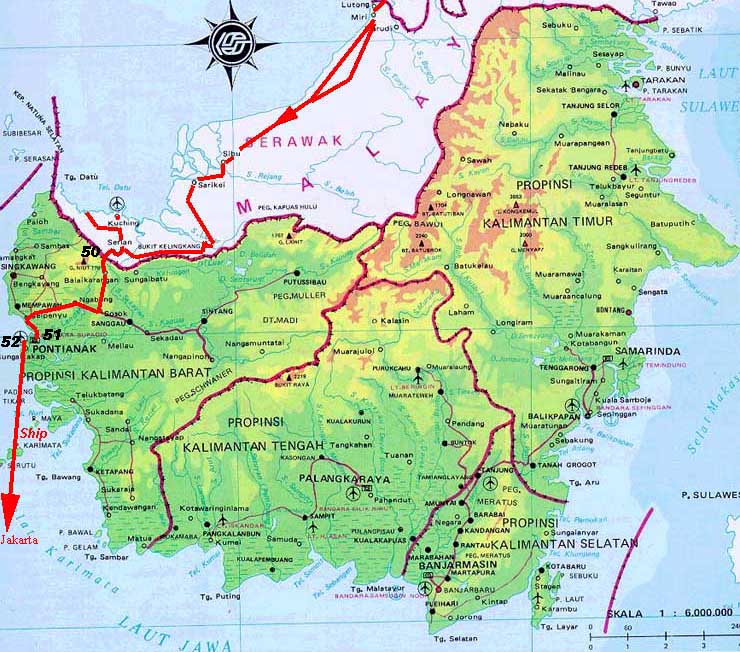
The Dayak or Dyak, are the indigenous people of the island Borneo; the third largest island in the world. This island is split up into three different states: Brunei, Indonesia, and Malaysia. Borneo is surrounded by the South China Sea. The Dayak people has historically lived along the major water ways such as the Kapuas river system (made up of the Mahakam, Barito, and Rajang rivers); living near large water sources is very common for tribes that have not industrialized and live off the land. Living on the river banks has multi-fold advantages. Some of these advantages include the accessibility of fresh water for both drinking and irrigation, the ability to take advantage of natural food sources (fishing), water-based transport for both trading and travel, and personal hygiene (bathing). Below is a map of the river system that runs though the island.
 
Borneo is made up of tropical and subtropical moist broadleaf forests (Borneo peat swamp forests), tropical moist forests (Kerangas forests), rain forests (Borneo montane rain forests), freshwater swamp forests, and mangroves (Sunda Shelf mangroves). The rainforests found in Borneo are around 130 million years old, making it one of the old rain forests in the world. Its is home to more than 15,000 different species of flowering plants, 300 species of trees, 221 species of mammals, and 420 species of birds.  There is also 440 species of freshwater fish. On top of that there are over 15 species of primate, including the endangered Sumatran orangutans. "Borneo and Sumatra are the only places on Earth where tigers, rhinos, orangutans, and elephants live together." (WWF)


List of References

  • MacKinnon, K et al. (1998). The Ecology of Kalimantan. London: Oxford University Press.
  • Nguyen, T.T.T., and S. S. De Silva (2006). "Freshwater Finfish Biodiversity and Conservation: An Asian Perspective", Biodiversity & Conservation 15(11): 3543-3568)
  • http://worldwildlife.org

Tuesday, February 11, 2014

Introduction to Cultural Blog

Throughout the coarse of the next couple weeks I will be getting to know the Dayak culture located in South East Asia. I will be studying the daily routines, economics, background, homeland/landscape, foods, and much much more. Hopefully I and in return my readers will be able to get a better understanding of the world and the vast complexities of the cultures that inhabit it.

I look forward to this experience.
Joshua Shields.


Dayak Bahau